
She did not know that the first document was not a threat.
It was an agreement.
Eight years earlier, when my parents refinanced their home after my father lost his construction business, the bank had refused the loan.
Their income was too unstable.
Their debt was too high.
The refinance happened only because I signed as a guarantor and agreed to make a substantial monthly contribution toward the mortgage.
The paperwork clearly stated something else.
If I permanently withdrew financial support, the lender had the legal right to reassess the loan and require immediate corrective action if the payments could no longer be sustained.
I had never mentioned that clause.
Neither had the bank.
There had never been a reason.
Until now.
I forwarded a copy of the agreement to my attorney.
Then I called him.
“I’d like every future conversation to go through your office,” I said.
“No personal arguments.”
“No emotional negotiations.”
“Everything documented.”
“That usually means something happened,” he replied.
“It did.”
“My parents turned away my minor daughter after a tornado.”
There was silence.
Then he quietly answered,
“We’ll handle this correctly.”
The fourth voicemail arrived before breakfast.
It was my father.
“You’ve made your point.”
“Now stop acting like a child.”
I deleted it without listening again.
An hour later another message arrived.
This time from my mother.
“Your father hasn’t slept.
Your sister is crying.
Is this really what you wanted?”
No mention of Olivia.
Not one word asking whether their granddaughter had been frightened.
Not one apology.
Only money.
Always money.
Eric looked over my shoulder.
“They still don’t get it.”
“No,” I said.
“They think the payment was the relationship.”
Three days later my attorney emailed me a summary.
Every financial contribution I had made over the past twelve years had been categorized.
Mortgage assistance.
Property taxes.
Roof repairs.
Medical bills.
Vehicle replacement.
Utility arrears.
Insurance premiums.
Emergency cash transfers.
School tuition.
Even grocery deliveries during the pandemic.
I stared at the total for a long time.
It was enough to have nearly paid off my own home.
Olivia happened to walk into the room carrying two mugs of coffee.
She saw my expression.
“Bad news?”
I turned the laptop toward her.
“No.”
“Just expensive lessons.”
She read the first page.
Then the second.
Her eyes widened.
“You paid for all of this?”
“For years.”
“Why?”
“Because I believed family protected each other.”
She looked down.
“They didn’t.”
“No.”
“They protected the people who never stopped taking.”
The following Monday my attorney sent formal notices.
Not demands.
Not lawsuits.
Simple notifications.
Effective immediately, all voluntary financial assistance had ended permanently.
Future communication regarding financial matters should be directed to legal counsel.
Nothing more.
Nothing less.
By noon my phone exploded.
Joan.
Mother.
Father.
Unknown numbers.
Even distant relatives.
“You’re humiliating your parents.”
“Blood comes first.”
“How could you abandon family?”
I listened to none of them.
Because every accusation ignored the same question.
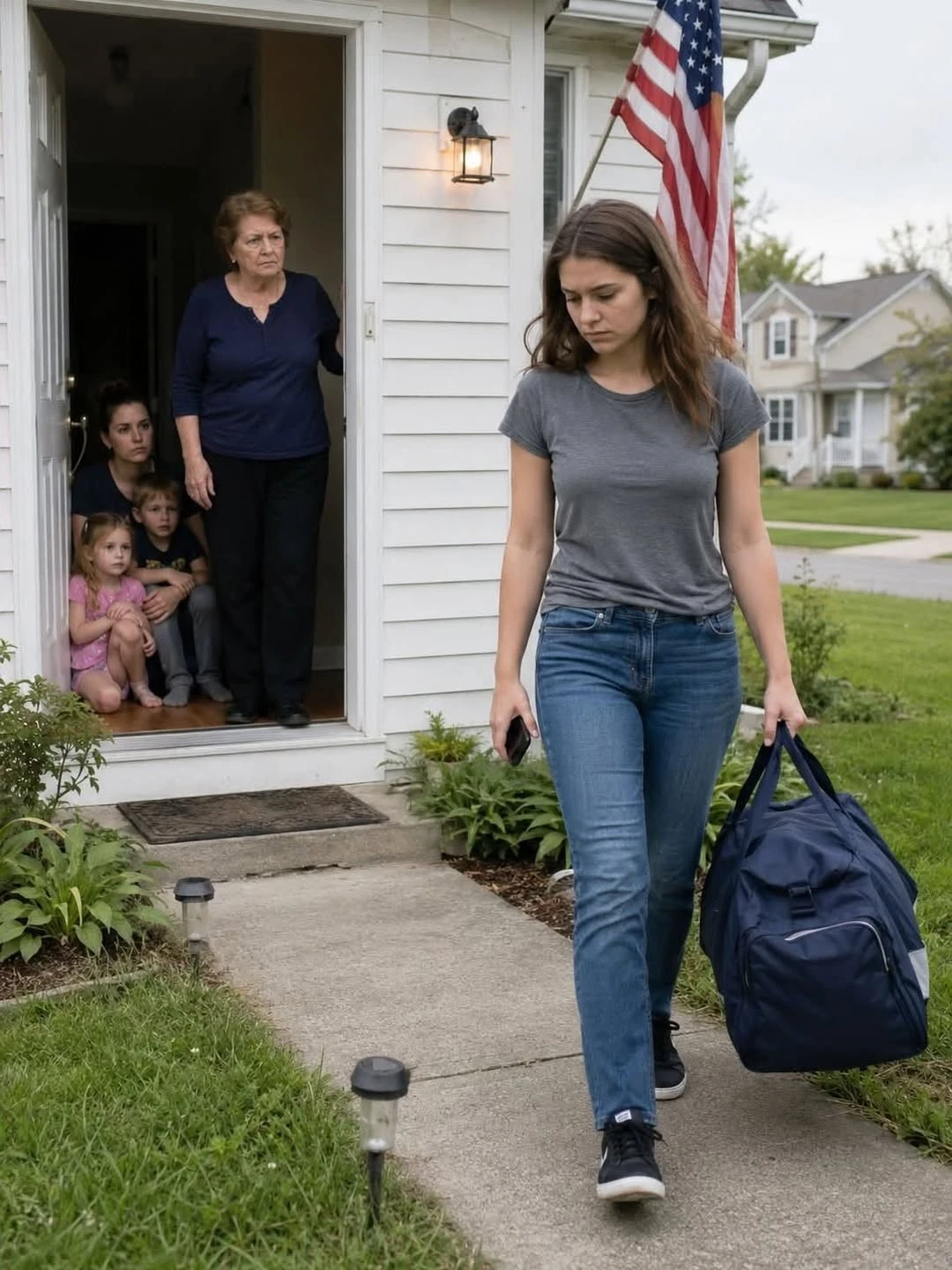
Where had that concern been when a sixteen-year-old girl stood outside with a suitcase while tornado sirens still echoed across town?
That evening someone knocked on our front door.
Olivia looked through the peephole.
“Grandma.”
“And Grandpa.”
I opened the door just enough to speak.
My mother immediately stepped forward.
“This has gone far enough.”
“We’re here to settle this.”
“You’ll restart the payments.”
I said nothing.
She mistook my silence for hesitation.
Then she smiled.
“I knew you’d come to your senses.”
Before I could answer, a sheriff’s deputy pulled into the driveway.
He stepped out holding a manila envelope.
“Dr. Carter?”
“Yes.”
“You asked us to deliver these once your family made in-person contact.”
“I did.”
He handed me the envelope.
Then he glanced toward my parents.
“Ma’am… Sir… you’ve both been formally notified.”
My father frowned.
“Notified of what?”
I opened the envelope.
Removed one photograph.
And placed it in my mother’s hands.
It showed Olivia standing alone outside their locked front door.
Suitcase beside her.
Tornado debris scattered across the yard.
The timestamp glowed in the lower corner.
Directly beneath it was another figure.
My sister’s SUV sat safely inside the garage.
Three empty guest-room windows were visible above it.
My mother’s face lost all color.
Then the deputy quietly said,
“You should probably turn over the photo.”
She did.
And on the back was the name of the person who had taken it—
The neighbor’s name was Margaret Ellis.
Seventy-two years old.
Retired elementary school teacher.
She had lived across the street from my parents for nearly three decades.
Almost everyone in the neighborhood simply called her Mrs. Ellis.
My mother stared at the signature on the back of the photograph.
“That old woman doesn’t know what she heard.”
The deputy didn’t answer.
He simply reached into the envelope again and handed me another document.
“This was also submitted.”
I unfolded it.
It wasn’t a statement.
It was footage.
Mrs. Ellis’s security camera had captured the entire front yard.
No audio at first.
Just Olivia standing with her suitcase.
Knocking once.
Then again.
Waiting.
Five minutes passed.
The front curtain moved.
My mother looked outside.
She disappeared.
Another minute.
Then the front door finally opened.
The camera’s microphone activated when the door swung wide.
Olivia’s voice was barely audible.
“Grandma… Mom said I could stay here until she gets off her shift.”
My mother’s answer came immediately.
“You’ll have to find somewhere else.”
Olivia looked confused.
“I don’t have anywhere else.”
“You’re sixteen. Figure it out.”
Then my father walked into view.
He didn’t invite her inside.
He didn’t ask if she was cold.
He picked up her suitcase.
Walked it back through the gate.
Placed it beside the sidewalk.
Then closed the gate between them.
Click.
The sound of the latch echoed through the recording.
A few seconds later came the words none of us had heard until that moment.
“If we let you stay,” my father said, “your mother will never stop expecting things from us.”
The screen went black.
Nobody spoke.
Not my mother.
Not my father.
Not even the deputy.
Finally my mother whispered,
“That isn’t what we meant.”
The deputy looked directly at her.
“Ma’am,” he said quietly, “intent usually matters.”
“But recordings matter more.”
The story spread through the neighborhood long before it reached the courthouse.
Not because of me.
Because Mrs. Ellis refused to stay silent.
When another neighbor asked why sheriff’s deputies had visited my parents’ house, she answered honestly.
“I watched a child get turned away after a tornado.”
“I wasn’t going to pretend I hadn’t.”
Within days, people I hadn’t spoken to in years began contacting me.
Some apologized for believing my parents’ version of events.
Others admitted something I had never known.
“You weren’t the first.”
An old family friend called one evening.
“Your parents have always treated you differently.”
“They just hid it better when you were younger.”
Another message came from one of my father’s former coworkers.
“I remember him bragging that you’d always bail them out.”
“I thought he was joking.”
He hadn’t been.
The mortgage company completed its review the following week.
Without my financial guarantee, my parents no longer met the required income threshold.
They were offered options.
Sell the property.
Refinance with another qualified guarantor.
Or bring the loan current under revised terms.
No one was throwing them onto the street.
No one was locking a door in their faces.
They simply had to live with financial reality—
the same reality they expected a sixteen-year-old girl to face alone after a tornado.
That Friday, I was halfway through another shift when security called the emergency department.
“Doctor Carter?”
“There’s someone here asking for you.”
“I’ll come down.”
I walked into the hospital lobby.
Joan stood near the entrance.
She looked exhausted.
Not angry.
Just tired.
“I only need five minutes,” she said.
I checked the clock.
“You have three.”
She swallowed hard.
“I didn’t know they were going to leave Olivia outside.”
I said nothing.
“I swear.”
“You lived in that house,” I replied.
“You saw her standing outside.”
Joan lowered her eyes.
“I…”
“You heard the door close.”
Tears filled her eyes.
“I didn’t think Mom would actually leave her there.”
“But you watched it happen.”
She couldn’t answer.
Instead, she reached into her purse and pulled out a single key.
She placed it on the table between us.
“My parents have been keeping something from you for years.”
I looked at the small brass key.
A faded label was still attached.
It read only one word.
SAFE.
Then Joan whispered the sentence that made me forget everything else happening around us.
“You’ve been paying for the house…”
“…but that’s not what they used your money to protect.”
the same neighbor who had already agreed to testify under oath about exactly who was told, “There’s no room for you.”
I looked at the key for several seconds.
It was old.
The brass had darkened with age, and one corner of the plastic tag had cracked.
“Where did this come from?” I asked.
Joan rubbed both hands together.
“Dad’s safe.”
“You’ve known about it?”
She nodded.
“Not everything inside.”
“But enough.”
I waited.
She took a slow breath.
“Mom made Dad promise that if anything ever happened to them, you’d never find it.”
The hospital lobby suddenly felt quieter than it really was.
Patients continued checking in.
Wheelchairs rolled across the polished floor.
Someone called for Environmental Services over the intercom.
Yet all I could hear was Joan.
“I can’t keep pretending anymore.”
She slid a folded piece of paper across the table.
It was an address.
Not my parents’ house.
A storage facility on the other side of town.
“My father moved the safe there after the refinance.”
“Why?”
“Because he didn’t want anyone asking questions.”
I did not go alone.
That afternoon, after my shift ended, Eric met me outside the hospital.
My attorney arrived ten minutes later.
So did a sheriff’s deputy.
No one wanted accusations later about missing documents or planted evidence.
The manager of the storage facility greeted us with a clipboard.
“Yes, ma’am.”
“Unit 214.”
“The account is under Robert Mason.”
The deputy glanced toward me.
“You’re ready?”
I nodded.
The steel door rattled upward.
Inside sat ordinary furniture.
Old boxes.
Camping equipment.
Christmas decorations.
Nothing unusual.
Then Eric pointed toward the back wall.
“There.”
A heavy gray fireproof safe.
Exactly where Joan said it would be.
I handed the brass key to the deputy.
It fit perfectly.
But the safe still required a combination.
My attorney looked at me.
“Any idea?”
I smiled without humor.
“My birthday.”
He turned the dial.
Nothing.
Eric tried Olivia’s birthday.
Nothing.
The deputy looked toward the paperwork clipped inside the storage unit.
“Try the refinancing date.”
I remembered it immediately.
The day I signed the guarantee.
The day I agreed to spend years helping my parents keep their home.
The lock clicked.
No one spoke.
The deputy slowly opened the safe.
Inside were folders.
Dozens of them.
Property records.
Bank statements.
Insurance policies.
Then my attorney froze.
“Don’t touch anything.”
He carefully lifted a thick envelope marked in my father’s handwriting.
PRIVATE – DO NOT SHARE WITH EMILY.
Emily.
My name.
My attorney opened the envelope while the deputy observed.
The first page made all four of us look at each other.
It wasn’t about the mortgage.
It was about me.
A typed ledger.
Every financial transfer I had ever made to my parents.
Every dollar.
Every check.
Every wire transfer.
But beside each payment was another handwritten column.
Actual Use.
Mortgage.
Crossed out.
Replaced with:
Joan’s credit card debt.
Roof repair.
Crossed out.
Replaced with:
SUV down payment.
Medical emergency.
Crossed out.
Replaced with:
Disney vacation.
College fund.
Crossed out.
Replaced with:
Kitchen remodel.
Page after page.
Year after year.
Almost every payment I believed had protected my parents’ home had quietly financed my sister’s lifestyle instead.
Eric stopped turning pages.
“How much?”
My attorney reached the final sheet.
He pulled out a calculator.
No one interrupted him.
Finally he looked up.
“Conservatively?”
He swallowed.
“Over six hundred and eighty thousand dollars.”
The number hung in the room.
I felt… nothing.
Not rage.
Not disbelief.
Just clarity.
For years I had wondered why every emergency in Joan’s life somehow became my responsibility.
Now I knew.
Because someone had already decided my money belonged to her.
Then the deputy removed one final envelope from the back of the safe.
Unlike the others, it wasn’t addressed to me.
It was addressed to the bank.
Across the front, in my father’s handwriting, were seven words that made my attorney immediately reach for his phone.
“Open only if Emily starts asking questions.”
